
What Is Discovery in a New Jersey Civil Lawsuit? A Business Owner’s Guide
Key Takeaways for New Jersey Business Owners
Discovery is when both sides exchange information about the lawsuit.
Before responding, your business may need to preserve records tied to the dispute.
The litigation track usually controls the discovery schedule.
Discovery requests may ask for written answers, documents, admissions, deposition testimony, expert reports, emails, texts, or other electronic records.
Incomplete or late discovery responses can weaken your defense and affect settlement leverage.
If your business has been sued in New Jersey, the complaint tells you what the plaintiff claims. Discovery is when both sides start asking for the information behind those claims.
For many business owners, this is when the lawsuit stops feeling like paperwork and starts touching the company itself.
This article explains what discovery means in a New Jersey Law Division, Civil Part lawsuit, how the process works, and what to expect when information requests begin.
What Discovery Means in a New Jersey Civil Lawsuit
In a New Jersey Law Division, Civil Part case, the New Jersey civil discovery rules allow each side to request information tied to the claims and defenses.
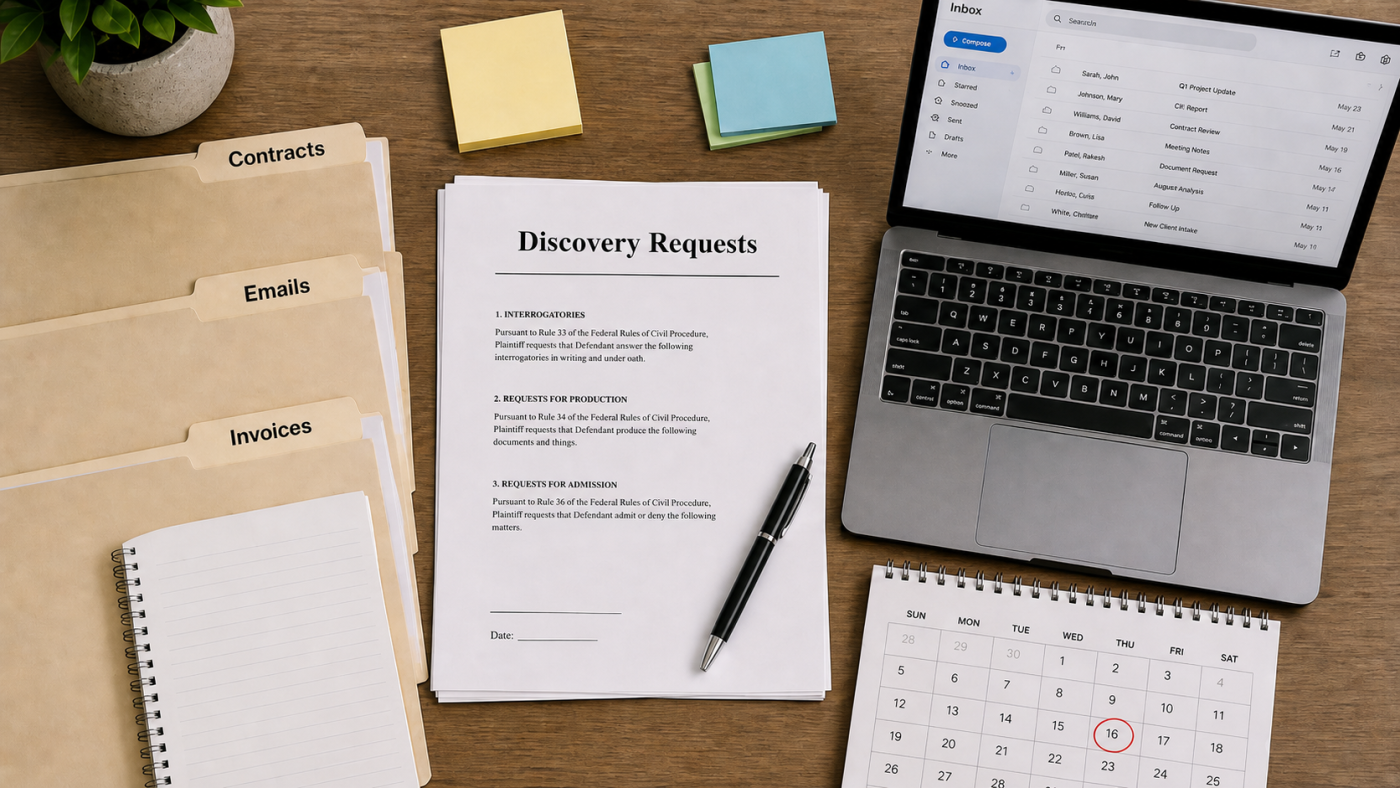
That can mean more than handing over the documents attached to the complaint. The opposing side may ask your company to search for, answer questions about, or produce:
Contracts and amendments
Invoices and payment records
Emails and text messages
Accounting records
Shared drive files
Cloud documents
Internal notes
Customer or vendor communications
Electronically stored information
Names of current or former employees with relevant knowledge
Testimony from owners, managers, employees, or company representatives
This process matters because it tests the lawsuit against the actual evidence.
Why Cases in the Law Division, Civil Part, Usually Involve Discovery
When the plaintiff’s complaint seeks more than $20,000 in damages, the case is filed in the Law Division, Civil Part of the Superior Court of New Jersey. Discovery is one of the main ways the plaintiff and defendant test what can be proven because these cases often involve:
Higher claimed damages
Factual disputes that need records or testimony
Disputed contracts or payment history
Witnesses who know different parts of the story
Possible expert issues
Motions or settlement decisions that depend on evidence
Where Discovery Fits in the New Jersey Civil Part Timeline
In a New Jersey Civil Part case, several things usually happen before your business starts exchanging documents, written answers, and testimony.
Here is the basic sequence:
The plaintiff files the complaint
This opens the case in court.The plaintiff files a Civil Case Information Statement
This form gives the court basic information about the case.The court assigns a docket number
The case is placed into the civil case management system. You can use that docket number to search for the lawsuit online. See our guide on how to check the status of your New Jersey civil case online for step-by-step instructions.
Your business is served with the summons and complaint
Once service happens, your response deadline starts to matter.Preserve relevant records
Your attorney may advise a litigation hold before discovery requests arrive.Your business files an answer or another response
This is where your side responds to the plaintiff’s allegations and may raise defenses or counterclaims.Your business may file its own Civil Case Information Statement
This gives the court your side’s case-management information.The court issues or confirms the Track Assignment Notice
This notice connects the case to a litigation track.The discovery period begins to matter in practice
The parties now know the schedule for completing discovery. Discovery does not necessarily stop if the court refers your case to mediation. Unless the judge orders otherwise, the parties may still need to meet discovery deadlines while mediation is underway. Learn more about mediation, arbitration, and trial in a New Jersey business lawsuit.
How Long Does Discovery Take In a New Jersey Civil Lawsuit?
In a New Jersey Law Division, Civil Part case, the discovery period is usually tied to the case’s litigation track. The Track Assignment Notice tells you which track applies and gives the discovery schedule the parties are expected to follow.
Litigation Track | Usual Discovery Period | What It May Mean |
Track I | About 150 days | A shorter schedule. Your business may need to gather documents and respond quickly. |
Track II | About 300 days | More time than Track I, but the deadline still needs to be managed early. |
Track III | About 450 days | Often used for more complex cases, including matters with heavier discovery, depositions, or expert reports. |
Track IV | 450 days or more | Usually reserved for highly complex cases with closer court management. |
For more detail on how Track I, Track II, Track III, and Track IV affect the discovery schedule, see our article on litigation tracks in New Jersey lawsuits.
The Main Types of Discovery
Common discovery tools include:
Interrogatories
Requests for documents, also called notices to produce
Depositions
Requests for admission
Interrogatories: Written Questions Under Oath
Interrogatories are written questions that one party sends to another during the discovery process. If you receive interrogatories, the answers should be prepared carefully because they may need to be verified or certified by a person with knowledge of the facts.
These questions may ask about:
Who was involved in the dispute
What your business says happened
Which documents support your position
Whether any payments or damages are disputed
What defenses your business raised in the answer
The risk is inconsistency. If you give a quick answer based only on one person’s memory, later records may create problems. Emails, invoices, accounting records, or deposition testimony may tell a more detailed story. Your answers should be based on the information reasonably available to the company, not guesswork.
Requests for Documents, Also Called Notices to Produce
A request for documents, also called a notice to produce, asks you to search for and produce relevant documents or other materialS.
Depositions: Testimony Before Trial
A deposition is testimony given under oath before trial, usually outside the courtroom. The opposing lawyer questions the witness, and a court reporter creates a written transcript that can be used later in the lawsuit.
A deposition may involve:
A business owner
A manager or employee with relevant information
A former employee
Another witness connected to the dispute
A company representative designated to testify for the business
For a defendant business, deposition preparation should start with the records. The witness should understand what they personally know, what the documents show, and where their testimony needs to stay consistent with previously written discovery responses.
Requests for Admission
Requests for admission ask you to admit or deny specific facts during discovery. They are used to narrow what remains disputed, so the parties do not spend time proving facts that should not require proof.
Requests for admission may ask you to admit or deny:
Whether a document is authentic
Whether a payment was made
Whether a communication was sent
Whether a contract was signed
Whether a specific fact is disputed
These requests deserve careful attention because a missed deadline may cause certain facts to be treated as admitted, depending on the rules and circumstances. Admissions can affect settlement, motion practice, and trial preparation.
Expert Reports
Some cases require expert reports during discovery. This happens when the dispute involves technical issues, valuation questions, financial analysis, construction defects, professional standards, or damages calculations.
If expert reports are involved, the discovery phase may become more demanding. Your attorney may need to work with an expert, review the other side’s expert opinions, and decide whether expert testimony should be challenged before trial.
Discovery is where much of the evidence that may later be used at trial is developed. Our guide to what happens at trial in a New Jersey civil lawsuit explains how that evidence is presented, challenged, and ultimately considered by the judge or jury.
Do Both Sides Have Discovery Obligations?
Yes. Discovery can go both ways. The plaintiff may send discovery requests to you or your business, and you may also send requests to the other party during the discovery phase.
The requesting party asks for information, documents, written answers, admissions, or testimony. The responding party must answer, object, or produce requested documents according to the applicable rule and deadline.
As the defendant, you cannot ignore discovery requests simply because you disagree with the complaint. The court still expects both parties to use the discovery process to gather evidence and evaluate the case.
Do You Have to Hand Over Everything the Other Side Asks For?
No. Discovery is broad, but it is not unlimited. A discovery request may be objectionable when it is:
Unclear
Too broad
Unduly burdensome
Unrelated to the claims or defenses
Seeking privileged information
Asking for protected material
Requesting confidential business information without safeguards
Speak to Our New Jersey Civil Litigation Attorneys Today
Stature Legal represents New Jersey business owners in civil litigation. Through a litigation strategy session, our business litigation attorneys, Daniel Bitonti can review the dispute, identify immediate concerns, and help you understand the next legal step. If your business has received discovery requests, we can also help you:
Understand what the other side is asking for
Identify what may need to be produced
Prepare specific objections where appropriate
Protect sensitive business information before documents or testimony are exchanged
Are you wondering about any of the issues mentioned above? Please email us at Info@staturelegal.law or call (732) 320-9831 for assistance.
At Stature Legal, we give business owners the clarity they need to fund, grow, protect, and sell their businesses. We are trustworthy business advisors keeping your business on TRACK: Trustworthy. Reliable. Available. Caring. Knowledgeable.®
FAQs
What Should My Business Do First After Receiving Discovery Requests?
Start by sending the requests to your attorney and noting the response deadline. Do not answer casually or send documents directly to the opposing side without legal review. Your attorney can help identify what is being requested, what records need to be searched, whether objections apply, and who inside the business may have relevant information.
Who Inside My Business May Need to Help With Discovery?
The right people depend on the dispute. In many business cases, the owner is not the only person with relevant facts. Managers, accounting staff, sales employees, project leads, former employees, IT vendors, or outside bookkeepers may have documents, emails, texts, or background information tied to the lawsuit. Your attorney can help decide whose records need to be reviewed.
What if My Business Does Not Have the Documents Being Requested?
You should not guess or ignore the request. Your attorney may need to determine whether the documents are truly unavailable, whether they are held by someone else, or whether your business has access to them through an outside vendor, accounting platform, email system, or former employee. If the documents do not exist or are not in your possession, custody, or control, the response should be handled carefully.
Can the Other Side Ask for My Company’s Confidential Business Information?
Yes, confidential information may still be discoverable if it is relevant and not privileged. That does not mean it should be handed over without safeguards. Depending on the case, your attorney may seek a confidentiality agreement, a protective order, redactions, limits on use, or limits on who can review the material.
What Happens if My Business Misses a Discovery Deadline?
A missed deadline can create problems quickly. The other side may send deficiency letters, file a motion to compel, seek sanctions, or argue that your business failed to comply with the discovery process. Missed deadlines can also hurt your defense by giving the opposing side leverage in settlement discussions or motion practice.