
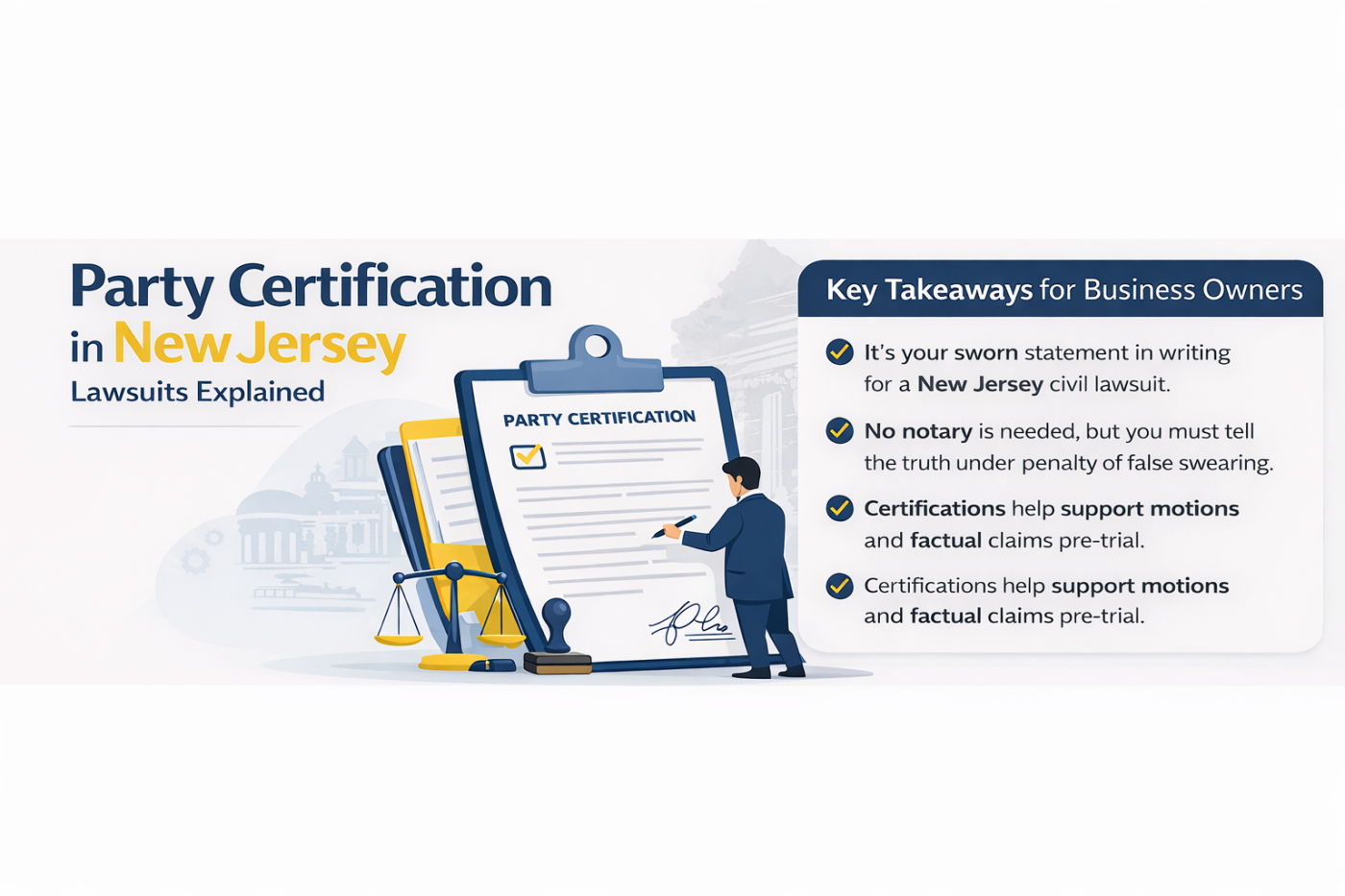
Key Takeaways for Business Owners
A party certification is your sworn statement in writing, used to tell the court what you personally know to be true in your New Jersey civil case.
It serves the same purpose as an affidavit, but does not require notarization under Rule 1:4-4(b) of the New Jersey Court Rules.
When you sign a certification, you are doing so under penalty of false swearing, meaning every statement must be truthful.
Certifications are commonly used to support pleadings, motions, and factual claims before trial, allowing judges to rely on verified facts without live testimony.
If your attorney prepares a certification, you must review and sign it yourself, since it contains facts from your personal knowledge.
Corrections can be filed if a mistake is found, but false statements can damage credibility or lead to legal penalties.
Certifications help your filings carry evidentiary weight, giving the court a factual foundation for decisions early in the litigation process.
Welcome back to our ongoing series for New Jersey business owners on what to do if you have been sued. If you’ve read our earlier articles explaining how civil cases move through the Law Division, Special Civil Part, Small Claims Section, and General Equity Part, you know that most of a New Jersey court case happens on paper long before anyone appears in a courtroom.
Your opportunity to tell your side of the story also happens in writing and under oath. That written statement is called a party certification. This article explains what it is and how it can help strengthen your case.
What Are Party Certifications?
In simple terms, a party certification is your sworn voice on paper. It is how you, as a person involved in a civil case, speak directly to the judge in a New Jersey Superior court through facts you know to be true. With this written voice, you can:
State facts from your personal knowledge, describing what happened, what you did, or what you did not do
Support your attorney’s arguments with real evidence, such as “I never received that invoice” or “The goods were delivered on time”
For you as the defendant, a party certification allows the court to rely on your sworn facts when deciding motions and other filings under the New Jersey Court Rules.
It protects your credibility before the court but also places responsibility on you because when you sign the document, you certify that every statement is true. A false certification can expose you to penalties for false swearing under New Jersey law.
For the lawsuit itself, party certifications provide the factual foundation for pleadings and motions. Each certification confirms that the facts stated in those documents are submitted under oath, giving the judge a reliable basis for making procedural and substantive decisions.
Is There a Difference Between a Party Certification and a Sworn Affidavit?
The other document that gives you a written voice in a New Jersey court is an affidavit. An affidavit is a sworn statement used to present factual information to a judge, just like a party certification. The purpose is the same: to provide sworn evidence in a civil case. The difference lies in the procedure.
An affidavit requires you to appear before a notary or another officer authorized to administer oaths. That official verifies your identity, watches you sign the document, and adds a notarial seal to confirm that the oath was given. A party certification, by contrast, allows you to swear to the truth of your statements yourself, using the required certification language under Rule 1:4-4(b), without a notary present.
Both documents are accepted under New Jersey law when filed in court. Under Rule 1:4-4(b), a certification may be used in lieu of an affidavit, oath, or verification required by the Court Rules.
In practice, certifications are the form most business owners and attorneys use when submitting documents to the court. Throughout this series, we will refer to the party certification as the standard way New Jersey defendants certify their facts in writing.
Final Words
We hope this article has helped you understand what a party certification is, how it compares to an affidavit, and why certifications have become the standard under New Jersey court rules. For business owners defending a civil case, this document is how you speak under oath, protect your credibility, and give the judge the verified facts needed to decide motions and other filings.
In our next article, we’ll explain what a Track Assignment Notice is, how it determines the timeline of your New Jersey lawsuit, and what it means for your case strategy moving forward.
If your business has been sued in New Jersey, our New Jersey business attorneys can help you protect your company and plan a defense strategy tailored to your situation. Contact us today to discuss your case and understand your options.
Are you wondering about any of the issues mentioned above? Please email us at Info@staturelegal.law or call (732) 320-9831 for assistance.
At Stature Legal, we give business owners the clarity they need to fund, grow, protect, and sell their businesses. We are trustworthy business advisors keeping your business on TRACK: Trustworthy. Reliable. Available. Caring. Knowledgeable.®
FAQs
Do I Have to Sign a Party Certification if My Attorney Prepares It?
Yes. If your attorney prepares a party certification, it must be signed by you because it contains facts within your personal knowledge. By signing, you certify that the statements are true under penalty of false swearing, as required by Rule 1:4-4(b). Your attorney can explain what each paragraph means before you sign to ensure accuracy and compliance with New Jersey court rules.
What Happens if There’s a Mistake in My Certification?
If you notice an error after signing, tell your attorney immediately. The lawyer can file a corrected or supplemental document with the court. Minor clerical issues can be fixed, but false or misleading statements can have serious consequences under New Jersey law, including exposure to false-swearing penalties.
Do I Still Need a Notary for My Certification?
No. Under Rule 1:4-4(b), you may use a certification in lieu of a notarized affidavit when the New Jersey Court Rules require one. Some statutes or agencies may still require a notarized affidavit.
Can I Use a Certification Instead of Appearing in Court?
A party certification can present your sworn facts in writing, but it does not replace your right — or obligation — to appear at hearings or trials if the judge requires your testimony. Think of it as your written testimony for the stages before trial, helping the court make procedural or evidentiary decisions.